On the promenade in Oostende stands a building you find nowhere else on the coast: a long colonnade, with the sea on one side and a hotel on top of it. The Koninklijke Gaanderijen were thought up for a king who wanted to walk to the horse races and stay dry.
A king with building plans
Leopold II had a great deal built in Oostende. The royal family had a chalet there on the promenade. The grounds around it had long lain neglected, and that bothered the king. He wanted to embellish the promenade between Oostende and Mariakerke, and so he bought up land.
Further along lay the Wellingtonrenbaan, the racecourse laid out in 1883. At the first meeting, Leopold II joined in giving the start. Between the chalet and the racecourse lay a stretch of open promenade, with wind and rain. A solution was found for that.
First the Venetiaanse Gaanderijen
The first gallery came in 1900. At the king's request, the architect Henri Maquet designed a closed, covered gallery in an L shape, with a large salon on the corner. It was built between 1900 and 1903. The name Venetiaanse Gaanderijen refers to the classicist architecture of Venice.
When the royal family no longer used its seaside residence, the city of Oostende was given the complex on concession, for a cultural purpose. The Venetiaanse Gaanderijen were renovated in 1998 and 1999, and since then they have been an exhibition space of the city. On the terrace in front stands a bronze statue of King Baudouin.
Nearly 400 metres of columns
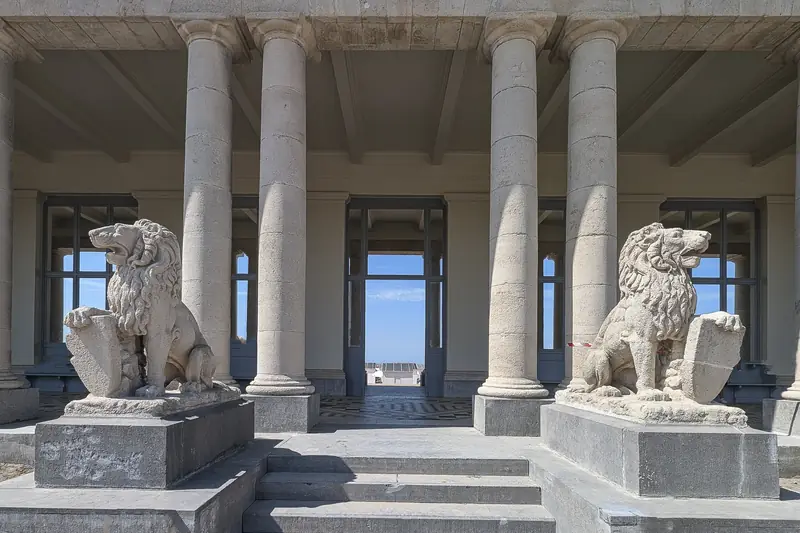
Then came the great work. The Koninklijke Gaanderijen were built between 1902 and 1906, to plans by the French architect Charles Girault, commissioned by the city and the king. They are about 380 metres long, and they lie between the Koninklijk Chalet and the racecourse.
The design is simple and stately. There are two colonnades side by side, partly separated by a glass wall. The king and his guests could choose which side they walked. The paired Doric columns were, so the architect said, meant to bring ancient Rome to mind. At each end stands a closed pavilion with a salon.
The king followed the works closely, and in February 1905 he came to look himself. He paid for part of the building from his personal fortune. The first phase was paid for with a grant the city received as compensation for the abolition of games of chance.
Between the Venetiaanse Gaanderijen and the Koninklijke Gaanderijen lie the Drie Gapers, with the equestrian statue of Leopold II.
The Thermae Palace on top
What you see rising above the columns today came only later. Leopold II already dreamed of a spa in Oostende, but the plan was carried out only between the two world wars. The city architect André-Louis Daniëls designed the Thermae Palace, an art deco complex built in the middle, above and behind the galleries.
It opened on 28 June 1933 as the Palais des Thermes, in the presence of King Albert I and Queen Elisabeth. There was a large hotel, a swimming pool of seawater and a thermal institute. It never quite became a success. The people of Oostende nicknamed it de Witten Ooljefant, the white elephant: expensive, and not very profitable. The pool served as the municipal swimming pool until 1976. Since 2002 the building has been protected heritage.
Traces of two wars
The galleries did not come through the twentieth century undamaged. In the First World War the wrought-iron railings between the columns were taken away to be melted down. In the Second World War the German occupier bricked the gallery shut along its whole length. The king's covered walk became a link in the Atlantikwall.
The painter Léon Spilliaert used the galleries as the setting for his painting La Nuit.
A walk on the promenade
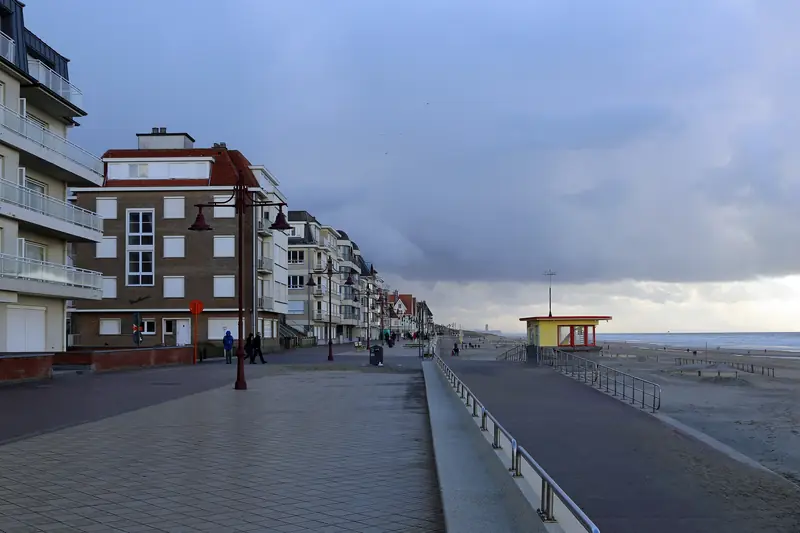
The walk is simple. Start at the Venetiaanse Gaanderijen and walk west along the promenade, with the sea on your right. You pass the Drie Gapers, and then you come to the long row of columns.
Allow for building works. In September 2025 a large renovation of the Koninklijke Gaanderijen and the Thermae Palace began. A part may stand in scaffolding, or be closed off. The promenade itself remains a fine walk, especially in autumn, when the light falls low over the water and the columns throw long shadows. Check the Toerisme Oostende website for the state of the works.
Finally
In a few hundred metres, the galleries tell how large the thinking was by the sea around 1900. A king, a racecourse and the wish to stay dry: nothing more was needed. View stays.
Sources: Toerisme Oostende: Koninklijke Gaanderijen, Toerisme Oostende: Venetiaanse Gaanderijen, Wikipedia: Koninklijke Gaanderijen, Wikipedia: Venetiaanse Gaanderijen, Wikipedia: Thermae Palace Hotel, Wikipedia: Wellingtonrenbaan