A day by the sea does not always have to be by the sea. Just behind the dunes lie four towns you can visit in half a day or a full day. They suit a grey day, or a day when your legs have seen enough sand.
Veurne: a market square from Spanish times
Veurne lies a few kilometres from the west coast and is the smallest step. The heart is the Grote Markt, laid out from 1586, together with the buildings around it. You will find the town hall, the Landshuis and the Spaans Paviljoen there.
The belfry rises above the Landshuis. The tower was finished in 1628 and is on the UNESCO World Heritage List, as part of the group of belfries in Belgium and France. Step into the town park as well. The Sint-Walburgakerk was never finished, and you can see that. The round shape of the streets goes back to a stronghold from the time of the Vikings.
Veurne is small. After a turn around the market and a coffee you have seen it, and that makes it ideal for a wet morning. On Wednesday there is a market.
Diksmuide: the IJzer and the war
Diksmuide is known as the Boterstad, after the dairy trade of earlier days. Most visitors come for another story. In the autumn of 1914 the Battle of the IJzer was fought here, and the town was destroyed completely. What you see on the Grote Markt today was rebuilt after the war in the old style.
On the bank of the IJzer stands the IJzertoren, a peace monument 84 metres high. On the base you read Nooit meer oorlog in four languages. The 22 floors are laid out as the Museum aan de IJzer, about war, peace and Flemish emancipation.
A little further along the river lies the Dodengang, a preserved stretch of Belgian trenches. The Belgian and German positions lay only a few metres apart there. It is a sober place that needs little explanation.
Diksmuide suits any weather: the museum is indoors, the Dodengang is outdoors. Allow half a day for it.
Damme: a quiet town on the canal
Damme lies 5 kilometres from Brugge and has only a few hundred inhabitants. In the Middle Ages that was different. Damme was then the outport of Brugge, on the Zwin. Seagoing ships unloaded their cargo there onto smaller vessels. When the Zwin silted up, the town fell quiet.
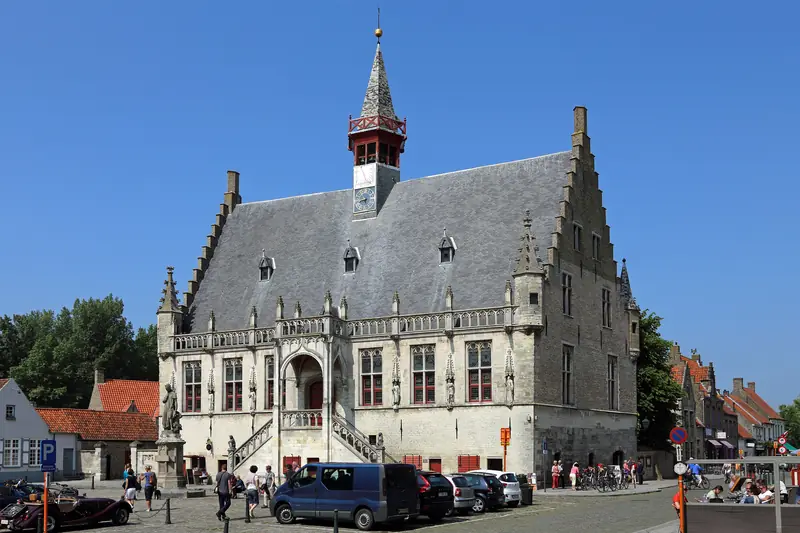
From that heyday the Gothic town hall and the large Onze-Lieve-Vrouwekerk remain. In front of the town hall stands a statue of the poet Jacob van Maerlant, who settled here in 1270. Damme is also the town of Tijl Uilenspiegel: in the novel by Charles de Coster he is born here.
The finest thing about Damme is the way there. The Damse Vaart is a canal lined with trees, about 15 kilometres long, from Brugge to Sluis in the Netherlands. Napoleon had the digging begun. Choose a dry day with little wind for this, because the wind has a free run across the polder.
Brugge: the classic
Brugge needs little explanation. The historic centre has been on the UNESCO World Heritage List since 2000 and came through the two world wars almost unscathed. You walk there along the reien, the canals that gave the city its nickname, Venice of the North.
On the Grote Markt stands the belfry, 83 metres high. Anyone who wants to go up climbs 366 steps. Other fixtures are the Burg, the Begijnhof and the Rozenhoedkaai.
Brugge is the best choice in the rain. There are enough museums, churches and cafés to stay indoors for a whole day. Go in the morning, or outside the weekend, if you want it quiet.
How to get there easily
Train and tram take you a long way.
- Veurne and Diksmuide lie on the same railway line, which starts at the station of De Panne. That station is in Adinkerke and is also the terminus of the coast tram. From Veurne, buses run to Nieuwpoort and De Panne, among other places.
- Brugge has direct railway lines to Oostende (Ostend), Blankenberge, Zeebrugge and Knokke. From the other resorts you first take the coast tram to one of those stations.
- Damme is reached most pleasantly from Brugge, on foot or by bicycle along the Damse Vaart. A tourist boat also runs between Brugge and Damme.
Times and timetables change. Check the websites of the NMBS and De Lijn shortly before you leave.
By bicycle, Veurne is a short ride from the west coast through the polder. For the other towns you do better to combine the bicycle with the train.
Finally
Four towns, four moods: a market square, a front line, a canal and a world city. With a stay on the coast you have all of them within reach, and in the evening you are back by the sea. View stays.
Sources: Wikipedia: Veurne, Wikipedia: Belfry of Veurne, Wikipedia: Diksmuide, Wikipedia: IJzertoren, Wikipedia: Dodengang, Wikipedia: Damme, Wikipedia: Damse Vaart, Wikipedia: Brugge, Wikipedia: Belfry of Brugge, Wikipedia: Railway line 73, Wikipedia: Veurne station