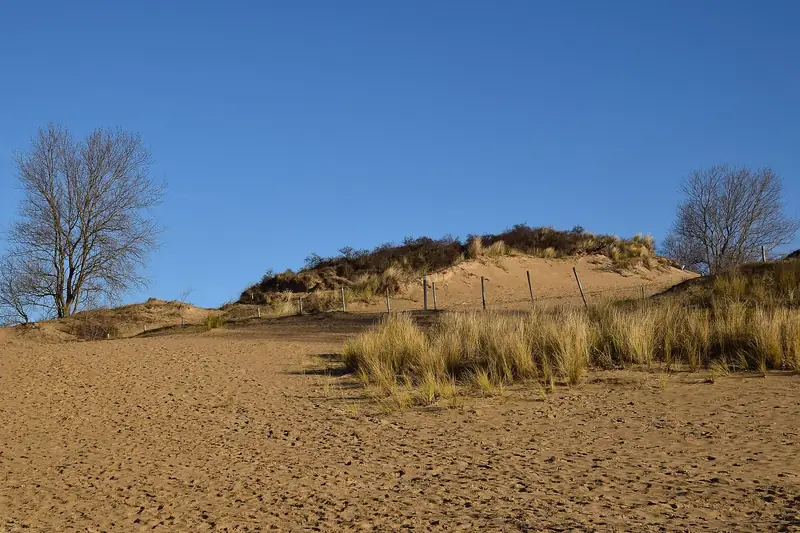
At 33 metres, the Hoge Blekker in Koksijde is the highest dune ridge on the Belgian coast. You can walk there all year round on the paths of the nature reserve. About 1.1 kilometres away lies a second dune area of 73 hectares, the Noordduinen.
Something special: the two do not belong to the same nature area. The Hoge Blekker forms one large dune massif with the Doornpanne and the Schipgatduinen. The Noordduinen lie apart, enclosed by houses, campsites and a military base. So you visit two areas.
The Hoge Blekker: highest dune on the coast
The Hoge Blekker in Koksijde is 33 metres high. The Agentschap voor Natuur en Bos calls it the highest dune ridge on the Flemish coast. The dune lies along the road between Koksijde-Bad and Koksijde-Dorp.
Blekker is the popular name for a bare dune hill that reflects the sunlight. Sailors saw the white crown shine from afar, and 'blekken' means to shine in the local dialect. For them the Hoge Blekker was a fixed beacon.
Horseshoe-shaped parabolic dunes lie at the origin of the dune. They formed between the 16th and the 19th century.
The nature reserve is open all year round to walkers on the paths. There is a separate route for riders. The Doornpanne has been a protected landscape since 1975 and belongs to the European Natura 2000 network.
The Doornpanne as a starting point
The Doornpanne, the Hoge Blekker and the Schipgatduinen together form a continuous dune massif of 240 hectares, writes Natuur en Bos. The De Doornpanne visitor centre is the welcome point for that area. Guided walks leave from there regularly, and there are temporary exhibitions.
According to Visit West-Vlaanderen, the Doornpanne walking route starts at the visitor centre in Koksijde and runs over the Hoge Blekker. Along the way you look out over the dunes and the polders behind them. If you find the route (8 kilometres according to Natuur en Bos) too long, choose the shorter loop of 5.6 kilometres.
The central walking and cycling path in the Doornpanne is made of shell clay. According to Natuur en Bos, wheelchair users can explore the nature reserve comfortably along it.
The Noordduinen in Koksijde
The Noordduinen in Koksijde are a dune area of 73 hectares. A busy road cuts the area in two. Dune grasslands, dune valleys, dune scrub and small woods alternate there. According to Natuur en Bos, you can enjoy the song of the nightingale and the flowering of the burnet rose.
During the redevelopment, three walking paths with posts were added. There is also a bridle path, a mountain bike path of 4.5 kilometres and there are two play areas.
If you want to see flowers and insects, choose spring or summer. Koksijde.com writes that the wild flowers in those seasons attract many butterflies, bees and other insects.
Dogs, donkeys and ponies on the paths
In the Noordduinen, donkeys and ponies keep the vegetation short in fenced grazing zones. According to the Natuur en Bos leaflet, that determines which path you choose.
- Copilliepad. This path has yellow posts and does not run through the grazing zones. It suits walkers with dogs.
- Massartpad and Loppenspad. These paths run mainly through the grazing zones. You may meet donkeys or ponies there. Dogs are not allowed.
If you walk with a dog, choose the Copilliepad. If you want to see donkeys and ponies, the Massartpad and the Loppenspad suit better, but then without a dog. For the Doornpanne, check the rules on the Natuur en Bos website.
Mill and abbey on the edge
The Zuid-Abdijmolen stands on the north side of the Noordduinen. The wooden mill is a protected monument. It was built in 1773 in Houtem-Veurne. In 1951 and 1952 it was taken down and rebuilt in Koksijde, to replace a local mill that had disappeared.
Close to the mill, the silhouette of the Duinenabdij dominated the landscape for centuries, writes Natuur en Bos. According to koksijde.com, the Abdijmuseum Ten Duinen lies about 500 metres from the Noordduinen and the mill about 350 metres. Read more in our article on the Abdijmuseum Ten Duinen.
A practical starting point for the Noordduinen is the car park next to Cinema Koksijde, writes koksijde.com.
How to combine the two
According to koksijde.com, the Hoge Blekker and the Noordduinen lie about 1.1 kilometres apart. The Noordduinen also connect to other walking areas around Koksijde, including the Hoge Blekker. Here is how to go about it:
- Start at the De Doornpanne visitor centre and walk over the Hoge Blekker.
- Then go to the Noordduinen in Koksijde.
- In the Noordduinen, choose the Copilliepad if your dog is with you.
- Finish at the Zuid-Abdijmolen or the Abdijmuseum Ten Duinen.
If you want a view, choose the Hoge Blekker. If you want peace among old dunes, choose the Noordduinen.
If you want even more dunes, read about the Westhoek in De Panne. If you then look for something to do in the municipality, have a look at the events in Koksijde.
Frequently asked questions
How high is the Hoge Blekker?
The Hoge Blekker in Koksijde is 33 metres high. Natuur en Bos calls it the highest dune ridge on the Flemish coast.
Is the Hoge Blekker open all year round?
Yes, the nature reserve is open all year round to walkers on the paths. According to koksijde.com, entry is free for walkers. Stay on the marked paths.
Can you take your dog into the Noordduinen in Koksijde?
On the Copilliepad with the yellow posts your dog may come along, because that path does not run through the grazing zones. On the Massartpad and the Loppenspad dogs are not allowed. Check the current rules on the Natuur en Bos website.
Can you reach the Hoge Blekker without a car?
Yes. The Oostduinkerke Schipgat bus stop lies at the De Doornpanne visitor centre, the starting point of the walk over the Hoge Blekker. The Kusttram stop with the same name is 300 metres away, writes Natuur en Bos. Plan your route on the De Lijn website.
Where do you stay near the Hoge Blekker?
The Hoge Blekker lies in Koksijde. On boekdekust.be you book holiday homes on the Belgian coast directly with the owner, and the booking is usually confirmed straight away. Read the guides to a holiday home in Koksijde and a holiday home in Sint-Idesbald to choose a place.
Finally
The Hoge Blekker gives you the view and the Noordduinen give you peace, and they lie about 1.1 kilometres apart in Koksijde. If you are torn between a holiday home and a hotel, first read holiday home or hotel on the coast. If you are looking for a place nearby, you can view holiday homes in Koksijde.
Sources: Natuur en Bos: Doornpanne and Hoge Blekker, Natuur en Bos: Noordduinen, Natuur en Bos: Noordduinen leaflet, Visit West-Vlaanderen: Doornpanne walking route, Wikipedia: Hoge Blekker, koksijde.com: Hoge Blekker, koksijde.com: Noordduinen