To get to the Belgian coast without a car, you take the train to a station by the sea and carry on by coast tram. The tram has 67 stops and runs every 10, 15 or 20 minutes during the day, according to De Lijn.
Something worth knowing: not every seaside resort has its own station. Koksijde station, for example, is in Veurne, not in Koksijde itself. If you travel without a car, you first pick the right station and only then the accommodation.
Which station for which resort
This is how it works for each resort:
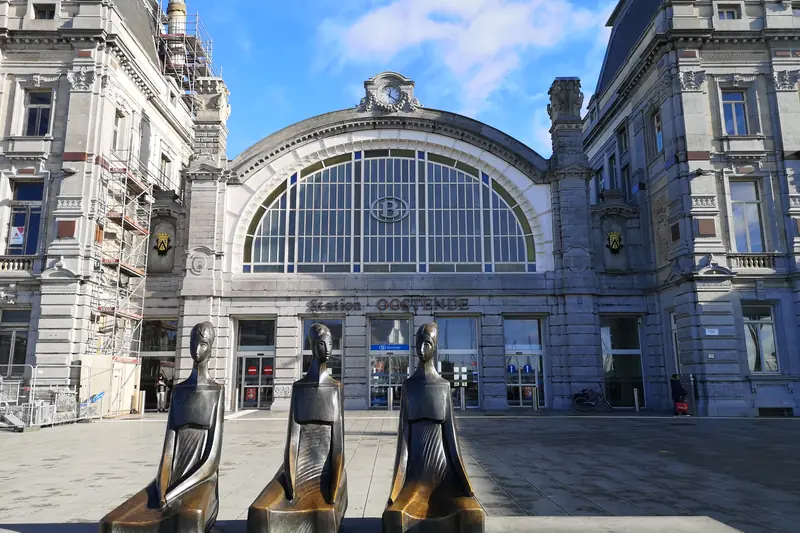
- Oostende: Oostende station is the terminus of railway line 50A. The tram station is built into the train station.
- Blankenberge: Blankenberge station is the terminus of line 51 from Brugge. The coast tram stop is directly opposite the station.
- Knokke-Heist: Knokke station is the terminus of line 51B, also from Brugge. The start of the coast tram line is about 250 metres from the station building.
- De Panne: De Panne station is in Adinkerke, the last Belgian station on line 73 before the French border. It is also the end of the coast tram line.
- Koksijde: Koksijde station is closer to the centre of Veurne than to that of Koksijde. For Koksijde-Bad and Sint-Idesbald it may be handier, according to Wikipedia, to ride on to De Panne and take the coast tram from there.
If your resort has no station of its own, pick the nearest one and carry on by coast tram.
Carrying on by coast tram
The coast tram runs from Knokke to Adinkerke, at the French border. The line is 67 kilometres long. For the whole line, allow about 2 hours 25 minutes, according to Wikipedia.
During the day the coast tram runs every 10, 15 or 20 minutes, depending on the period. In the evening there is a tram every 30 minutes. In summer it runs every 10 minutes, according to the municipality of De Panne. Check the De Lijn timetable before you leave.
De Lijn sells passes for one or more days of unlimited travel on the coast tram. In the De Lijn app you buy your ticket and follow the ride on the map.
You can read the story of the line itself in the facts about the coast tram.
Taking or hiring a bike
On the train, it depends on the type of bike. A folding bike travels free, if you stow it under the seat during the ride. For other bikes you need a separate Fiets Supplement ticket before you board. Check the current conditions with NMBS.
Ordinary bikes are also allowed on the coast tram, but only with a bike ticket and if there is room. This is how it works:
- Bike ticket: it is valid for one hour, for a bike or an e-bike. You also buy a ticket for yourself.
- Where to buy: at a ticket machine on the coast or at the De Lijn shop at Oostende station.
- Scanning: if you travel with several people, you scan for each bike separately.
- Loading it yourself: you lift your bike on and off the tram yourself. A maximum of two bikes are allowed per tram. When it is very busy, the driver can refuse bikes.
If you have more than two bikes, hiring on the spot suits better than bringing them. According to Vlaanderen.be, you find Fietspunten mainly at train stations, and there you can also hire a Blue-bike. In De Panne there is a Blue-bike at the station. According to Wikipedia, Knokke station has a Fietspunt.
The routes themselves are in the post about cycling along the Belgian coast.
Luggage and prams
De Lijn allows a maximum of two items of hand luggage of reasonable size per traveller. A suitcase of normal size, a rucksack and a pram count among them. When the tram is overcrowded, the driver can refuse luggage. If you travel with a lot of luggage, avoid the busy hours.
Mind the step into the train too. According to Wikipedia, the platform at De Panne station is 28 centimetres high, and at Oostende and Blankenberge 76 centimetres. At De Panne the platform is therefore lower and the step up into the train bigger, even with a heavy suitcase.
Choosing accommodation near a station or stop
De Lijn has an overview of all the coast tram stops. Lay it next to the location of the accommodation.
How to choose:
- If you want to go from the train to your stay without a detour, Oostende, Blankenberge or Knokke suit well. Station and tram are close together there. Also read about a holiday home in Oostende.
- If you stay in Heist, the coast tram runs between Heist station and Knokke alongside the railway. Also read about a holiday home in Heist.
- If you are looking for a stay in Koksijde-Bad or Sint-Idesbald, it may be handier to take the train to De Panne and carry on by coast tram. You will find more on this under holiday home in Koksijde.
- If you want to stay in the centre of De Panne, choose accommodation near a tram stop. According to the municipality, the station is 3 kilometres from that centre.
Frequently asked questions
How do you get to the Belgian coast without a car?
By train to Oostende, Blankenberge, Knokke or De Panne, then by coast tram to the stop near your stay.
Can you take your bike on the coast tram?
Yes, with a bike ticket and if there is room. According to De Lijn's travel conditions, a maximum of two bikes are allowed per tram.
Can you take your suitcase on the coast tram?
Yes, up to two items of hand luggage of reasonable size per traveller, for example a suitcase of normal size or a pram.
Does the coast tram run at night?
According to Wikipedia, the coast tram only runs all night on New Year's night, once an hour. Read more in the post about Christmas and New Year by the sea.
Where do you stay on the Belgian coast without a car?
Choose a holiday home near a coast tram stop or station. On boekdekust.be you book holiday homes on the Belgian coast directly with the owner, and the booking is usually confirmed at once. Guests pay a service fee.
Finally
Getting to the coast without a car takes a little preparation. Pick the station, find the stop near your accommodation and allow for limited space for bikes and luggage. If you are looking for a stay near a stop, you can view holiday homes on the coast.
Sources: De Lijn, Coast tram, De Lijn, Bike ticket, De Lijn, day trippers, De Lijn, general travel conditions, Vlaanderen.be, public transport and bikes, Visit De Panne, by train, Visit De Panne, by tram, Visit De Panne, by bike, Wikipedia, Coast tram, Wikipedia, Oostende station, Wikipedia, Blankenberge station, Wikipedia, Knokke station, Wikipedia, De Panne station, Wikipedia, Koksijde station