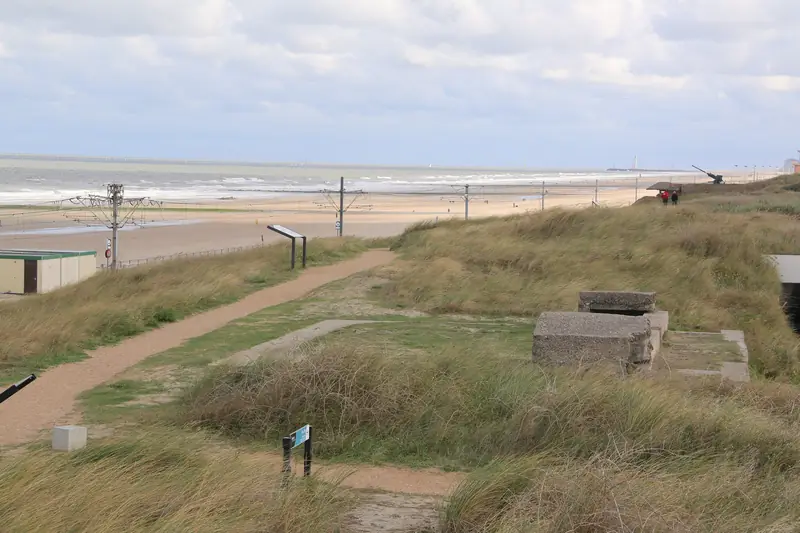
Between Oostende and Middelkerke the dunes look quiet. Even so, there is concrete under the marram grass. At Raversyde you walk through bunkers, passages and gun positions that the German occupier built in two world wars. It is one of the best-preserved stretches of the Atlantikwall.
A royal estate in the dunes
The story begins with King Leopold II. In 1902 the royal family bought land behind the dunes at Raversijde. The king had a wooden residence built there, the Noorse Chalet. That building disappeared in the First World War, when the German army took the site for a coastal battery.
A word about the name. The hamlet is called Raversijde. The estate and the museum spell it Raversyde. Until 1971 it belonged to Middelkerke, and since then to Oostende.
Battery Aachen from the First World War
Work on Battery Aachen began on 8 January 1915. By the end of April that year it was already in use. The guns stood under steel cupolas. A narrow-gauge railway linked the gun positions to the ammunition rooms, hidden in the dunes.
What remains are two observation posts, four gun emplacements and a bomb-proof shelter. According to the museum, this is the best-preserved German coastal battery from the First World War. The battery was thoroughly restored and fitted out again, and for that it received a European Heritage Award in 2022. You learn how daily life went in such a battery, and on the occupied coast. It lies in rolling dunes with a view of the sea.
Saltzwedel-neu and the Atlantikwall
In the Second World War the army came back. Battery Saltzwedel-neu dates from 1941 and was first meant to defend the harbour of Oostende. After 1942 it was brought into the Atlantikwall, the German defensive line along the coast.
This part is the largest. You will find more than sixty bunkers, open passages and underground ones, observation posts and gun positions. Part of it has been restored to its original state. You walk through trenches and passages from one bunker to the next, and so you get a clear sense of how the soldiers lived and worked here.
By the entrance stand restored pieces from the collection, including an Enigma, the cipher machine of the German army. There is also a coastal panorama 75 metres long, with photographs from 1945.
The prince who let nothing be demolished
That it is all still there is the work of one man. Prince Charles (prins Karel), the second son of King Albert I, was regent of Belgium from 1944 to 1950. After his regency he withdrew from public life and went to live on the estate at Raversijde. He drew and painted there under the name Karel van Vlaanderen.
After the war, demolition threatened here too. Prince Charles owned the land and kept resisting the demolition. He stayed on the estate until his death in 1983. Today it is a provincial estate, and both batteries are protected as monuments.
Practical notes for your visit
The museum is an open-air museum. Count on wind, sand and stairs.
- Wear sturdy shoes, and bring a coat even on a sunny day.
- Part of the passages runs underground. For young children it is an adventure, but keep them close to you.
- Battery Aachen is accessible to wheelchairs with someone to help, and to pushchairs. For Saltzwedel-neu, a baby carrier is the better choice if you have a baby with you.
- Animals are not allowed in the museum, except guide dogs. In the park of the provincial estate you may walk a dog on a lead.
The museum is not open all year. The park of the estate is open all year. Check the opening period and the hours on the Raversyde website before you set off.
The coast tram runs here along the promenade, right beside the beach. On a bike you simply follow the coast between Oostende and Middelkerke.
Finally
Raversyde is not a museum of glass cases. You stand in the dunes, in the concrete itself, with the sea beside you. That makes it a strong outing even for someone with little interest in war history. View stays.
Sources: Raversyde, Toerisme Oostende, Wikipedia: open-air museum Atlantikwall, Wikipedia: Raversijde, Wikipedia: prins Karel