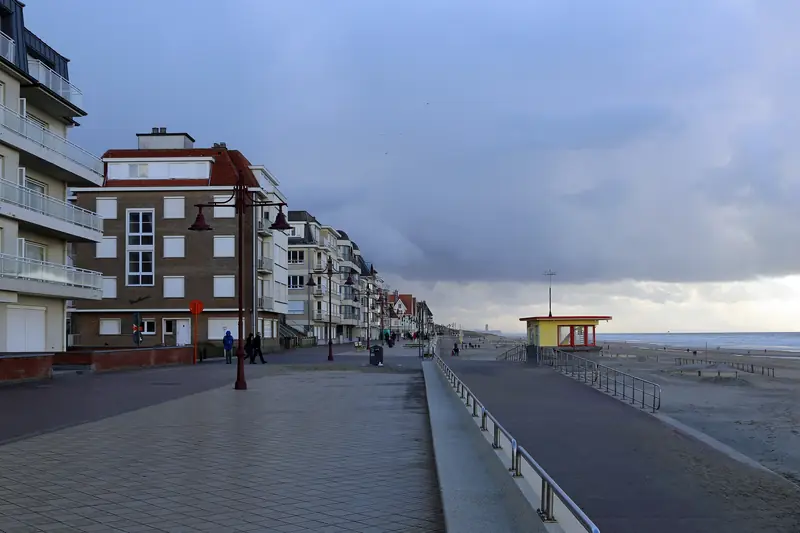
Step off the coast tram in De Haan and you notice it at once. There is no wall of flats facing the sea. You see villas with turrets, wooden balconies and a great deal of green. That quarter is called the Concessie, and its story begins with a piece of dune and a contract.
A contract for 50 hectares of dune
Well into the nineteenth century, De Haan was a hamlet of a few huts behind the dunes. It lay on the land of two polder villages, Vlissegem and Klemskerke. In the course of that century the dunes were planted, and a large dune wood grew there.
The change came with the steam tram between Oostende and Blankenberge, which ran from 8 August 1886. Two years later, on 22 July 1888, the resort and the first hotel were officially opened. On 29 July 1889 a Royal Decree approved a contract between the Belgian State and two architects, among them Eduard Colinet from Oostende. They leased 50 hectares of dunes in order to lay out a seaside resort. That concession was later sold on and extended. The quarter that grew there took its name from it.
A villa park with strict rules
De Haan was to remain a villa park. Anyone building had to take the planting into account, and only a sixth of the ground could be built on. That explains the roomy gardens and the winding avenues you still see today.
In 1910 the architect and town planner Hermann-Josef Stübben drew a plan for the resort. His starting point was no high-rise, and as much woodland as possible as shelter from the wind. That line has never been dropped altogether. High-rise of more than five storeys is still forbidden in De Haan-Centrum. The Concessie is also on the list of the 50 most beautiful villages in Flanders.
Around the turn of the century, foreign guests were already coming, above all the English and the French. In 1899 the resort was given a casino, which was pulled down again in 1929.
The tram station of 1902
The best-known building in De Haan is small. The tram station dates from 1902 and fits the style of the villas around it. It replaced a plain little building of zinc sheets, known locally as the blekken statie. In the attic there is still a water tank from the days of the steam trams.
It very nearly vanished. In 1977 the building was under threat, and the municipality then bought it for a symbolic franc. In 1981 it became a protected monument, and in 2002 it was fully restored. Today it is a tourist information point. It is also the only old tram station of the Belgian vicinal railways where an ordinary tram still stops.
Building materials for the villas used to arrive by tram, at an unloading point beside the station. The quarter was literally built with the tram.
Einstein by the sea
In 1933 De Haan gained a famous resident. Albert Einstein and his wife Elsa were on their way back from the United States when Hitler came to power in Germany. On 28 March 1933 their ship, the Belgenland, docked in Antwerpen. Einstein decided not to return to Germany. He went by train to Oostende and from there by coast tram to De Haan.
The couple took rooms in villa Savoyarde, in the Shakespearelaan. Einstein received friends there, among them the painter James Ensor. Because he was under threat, the gendarmerie of De Haan had to keep a discreet watch on him. In early September 1933 he left for England, and later that year he left for good for the United States.
You look at the villa from the street. In the Normandiëlaan a statue of Einstein has stood since 2006. There is also a walking guide, In de voetsporen van Einstein (In the footsteps of Einstein), which leads past eighteen places in the quarter.
How to walk through it
Start at the tram station. From there you are in the avenues of the Concessie within a few minutes. You do not need a fixed route. Follow the curving streets and look at the details:
- wooden bays and balconies
- turrets and pointed gables
- half-timbering in the facades
- gardens with hedges instead of walls
At the tram station you can ask the information point for walking maps. The quarter is at its loveliest in the soft light of morning or late afternoon. Outside summer it is worth it too: with no leaves on the trees, you see the facades more clearly.
Finally
The Concessie shows what a seaside resort can look like when someone, long ago, decided to build low and green. You need an hour for it, or a whole afternoon if you like to linger. View stays.
Sources: Wikipedia: De Haan-Centrum, Wikipedia: De Haan, Wikipedia: tram station De Haan aan Zee, Wikipedia: statue of Albert Einstein