The Duinenkerkje, officially the Onze-Lieve-Vrouw-ter-Duinenkerk, stands on the edge of Mariakerke in Oostende on the Belgian coast. The church has been a protected monument since 1946. The painter James Ensor is buried in the churchyard next to it.
This little church has been through a lot, from building plans to war. In 1894 Ensor helped organise a protest against its demolition. According to VRT NWS, the open strip of dunes around it probably would not have been preserved without the little church.
A church in the dunes
The Duinenkerkje stands on the edge of Mariakerke, a district of Oostende. Mariakerke was an independent municipality until 1899, VRT NWS writes. The church stands in a protected landscape of dunes and polders.
The sources give different details about the age of the Duinenkerkje. The City of Oostende says the church was built between 1350 and 1400. VRT NWS speaks of the fourteenth century. Wikipedia describes a brick church from the second half of the fourteenth century and mentions a parish with a chapel on the same spot as early as 1071.
The protection came in stages. The Duinenkerkje was protected as a monument in 1946, the churchyard as a cultural and historical landscape in 1975 and the wider surroundings as a village view in 1981, the City of Oostende writes. Since 2009 the church and churchyard have also been architectural heritage.
Inside, Wikipedia calls the painting above the high altar the showpiece of the church. It shows shipwreck survivors in a raging sea.
A church that almost vanished
In 1894 a new plan provided for the demolition of the Duinenkerkje and the building of a larger church. Sharp protest arose, organised by James Ensor and supported by, among others, August Vermeylen. The plan stayed a plan, Wikipedia writes.
In 1903 the Commission for Monuments and Landscapes took charge of the dilapidated little church. In 1905 it was fully restored.
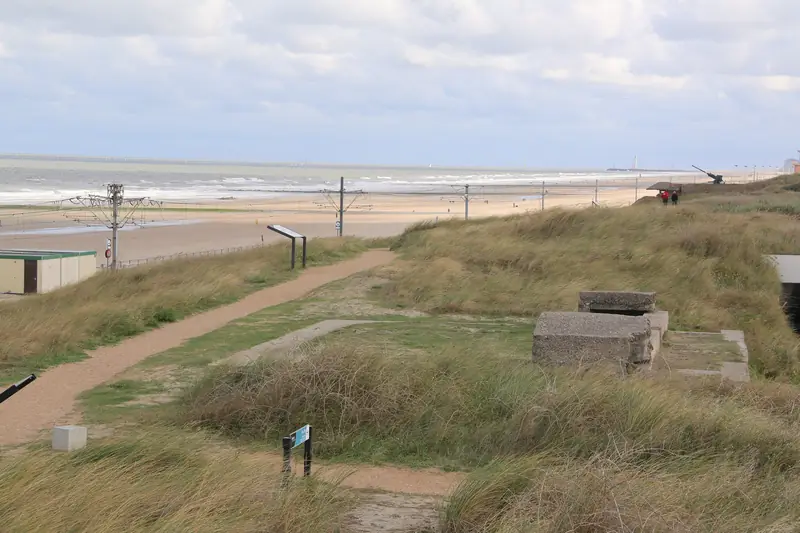
During the First World War the German coastal battery Cecilia stood opposite the Duinenkerkje. The Germans had the tower cut in half, fearing it would be a target for Allied guns firing from the sea. In 1929 the rebuilding of the tower began. On 22 May 1931 the church solemnly reopened.
The churchyard
The churchyard of the Duinenkerkje in Mariakerke is trapezium-shaped. You will mostly see small patches of grass, a few weeping trees and ornamental shrubs. The City of Oostende leaves it as it is and no longer holds burials there.
Several well-known Mariakerke families rest in the churchyard. Three former mayors of Oostende are buried there: Arnold Hoys, J.B. Lanszweert and Henri Serruys. Wikipedia also names Leopold Passchyn, the last mayor of the independent municipality of Mariakerke.
The churchyard is a burial ground. Keep it quiet there.
Ensor's grave
James Ensor died on 19 November 1949 in Oostende. He is buried next to the tower of the Duinenkerkje, among the dunes and close to the sea.
He chose that spot himself. According to VRT NWS, Ensor made an agreement with the parish during his lifetime: a burial plot in exchange for a church service. Since then the church has also unofficially been called the Ensorkerkje.
Every year on 13 April, Ensor's birthday, flowers are laid on his grave. In April the Ensor commemoration also takes place at the little church. The sources give no fixed date. Check it beforehand.
In 1901 Ensor painted the church and the village in Gezicht op Mariakerke. That painting hangs in Mu.zee Oostende. You can read more about the painter in James Ensor and Oostende: on the trail of the painter of the masks.
The dunes around the little church
According to VRT NWS, the strip of dunes from Mariakerke to Middelkerke, interrupted only by little Raversijde, is the only open strip of dunes left on the middle coast. Toerisme Oostende reports that the landscape of dunes and polders and the area around the church were recognised as protected landscape in 1979 and 1981.
Next to the Duinenkerkje, according to VRT NWS, there is also one white, protected fisherman's cottage. You can find a route along the sea wall and through the dunes in walking from Mariakerke to Raversijde.
The strip reaches into Middelkerke. If you would rather stay there, read about a holiday home in Middelkerke.
How to get to the Duinenkerkje
Toerisme Oostende names these ways, among others, to reach Mariakerke:
- By coast tram. Line KT stops in Mariakerke, among other places at Mariakerke Bad and Mariakerke Duinenkerkje.
- On foot. Walk along the sea wall or through the Provinciedomein Raversyde.
- By bike. Follow the coastal cycle route or the sea wall from Oostende.
In bad weather the tram service between Oostende Station and Westende Bad may be temporarily interrupted. Buses then take over. Check the timetable on the De Lijn website.
If you want to look inside, check beforehand whether the church is open. The churchyard is always accessible, says the City of Oostende. If you want to stay in Mariakerke itself, you will find more in holiday home in Mariakerke: Duinenkerkje, sea wall and dunes.
Frequently asked questions
Where is the Duinenkerkje of Mariakerke?
The Duinenkerkje is on the edge of Mariakerke, a district of Oostende on the Belgian coast. On the coast tram, you get off at the Mariakerke Duinenkerkje stop.
Where is James Ensor buried?
James Ensor is buried in the churchyard of the Duinenkerkje in Mariakerke, next to the tower of the church. He died on 19 November 1949 in Oostende.
Is the churchyard of the Duinenkerkje always open?
The City of Oostende says the churchyard is always accessible. For the church itself, check beforehand whether it is open.
When is the Ensor commemoration in Mariakerke?
The Ensor commemoration takes place every year in April at the Duinenkerkje. On 13 April, Ensor's birthday, flowers are laid on his grave.
Where can you stay near the Duinenkerkje in Mariakerke?
On boekdekust.be you book holiday homes on the Belgian coast directly with the owner, and the booking is usually confirmed straight away. Guests pay a service fee. If you are torn between seaside resorts, read which coastal town suits you.
Finally
The Duinenkerkje in Mariakerke is small, but it carries a lot of history: a protected church, a peaceful churchyard and Ensor's grave among the dunes. Combine the visit with a walk along the sea wall or a ride on the coast tram. If you are looking for a place to stay, you can view holiday homes in Mariakerke.
Sources: City of Oostende, Mariakerke churchyard, Toerisme Oostende, Church of Our Lady of the Dunes, Toerisme Oostende, The grave of James Ensor, Toerisme Oostende, Mariakerke and how to get there, VRT NWS, The man who saved the last open strip of dunes on our middle coast, Wikipedia, Onze-Lieve-Vrouw-ter-Duinenkerk (Mariakerke)), Wikipedia, Mariakerke (Oostende))