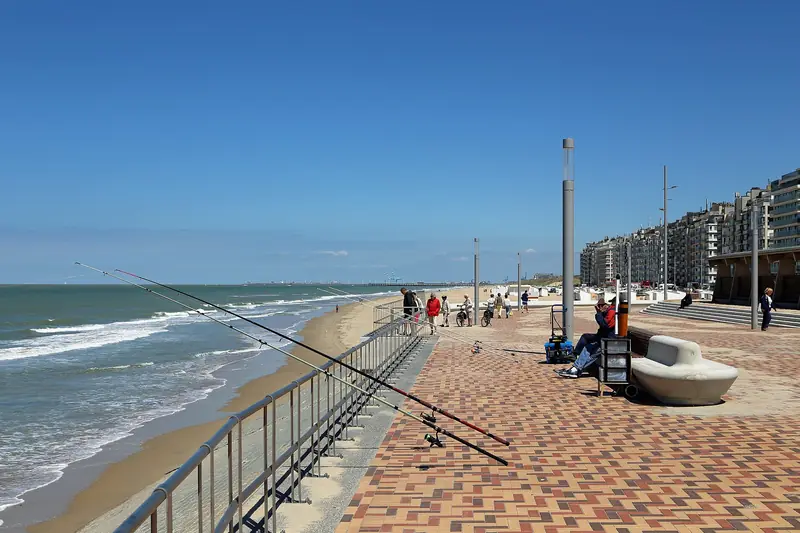
Wenduine is a seaside resort on the Belgian coast and a district of De Haan. In the Middle Ages it was a fishing village: in 1185 it got its own parish, in 1335 a harbour is already mentioned, and in 1340 the fishermen were given permission to catch porpoises. It has been a seaside resort since 1886, when the steam tram began to run there.
In between, from the middle of the 16th century, Wenduine fell back to being a farming village. So the resort is young. You can still find traces of that history: a wooden windmill from 1880, the roundabout of the Astridplein and a coat of arms with a porpoise.
A short overview
- 1185: the parish is founded and Wenduine is mentioned in writing for the first time, as Weinduna.
- 1335: a harbour is already mentioned.
- 1340: the fishermen are given permission to catch porpoises.
- Around 1350: a fishermen's guild appears.
- 15th century: storm surges and, in response, the Graaf Jansdijk.
- From the middle of the 16th century: fishing falls into decline.
- 1886: the steam tram runs, the resort begins.
- 1888: villa building starts.
- 1902: an urban development plan with a roundabout, completed in 1924.
- 1977: Wenduine merges into the new municipality of De Haan.
A fishing village in the Middle Ages
A Gallo-Roman settlement was found in the Wenduine area. That occupation disappeared around 270, after raids by Germanic pirates and floods on the coastal plain. According to Wikipedia, people are said to have settled there again in the 8th century, Frankish colonists who fished there.
Wenduine first fell under the parish of Uitkerke. In 1185 it got its own parish. The first written mention of the name Weinduna dates from that year. According to Wikipedia, what that name means is a matter of speculation.
In the 13th and 14th centuries Wenduine was important as a fishing place. In 1335 a harbour was already mentioned. In 1340 the fishermen were given permission to catch porpoises. The harpooned porpoise in the coat of arms of Wenduine recalls that. Around 1350 a fishermen's guild was formed.
Storm surges and decline
In the 15th century storm surges came. In response, the Graaf Jansdijk was built. Villages such as Tarninge and Mosselinge disappeared, through floods or through drifting sand.
In 1488 the cloth industry came to an end, after the Flemish revolt against Maximilian. From the middle of the 16th century fishing fell into decline. According to Wikipedia, the religious troubles were partly to blame. Wenduine declined into a farming village. Around 1796 it became an independent municipality, but it knew little prosperity.
The legend of the Holy Cross begins with a storm surge that flooded Oud-Wenduine. A long time later, fishermen from Blankenberge pulled a large cross out of the sea. That legend belongs to the blessing of the sea on Whit Monday, which you will find explained in the blessing of the sea in Wenduine.
How did Wenduine become a seaside resort?
In 1884 Wenduine got a paved road to Blankenberge. Blankenberge was already a seaside resort at the time.
It has been a seaside resort since 1886. That year the steam tram line between Oostende, Bredene, De Haan, Wenduine and Blankenberge began to run. That made Wenduine truly accessible. The line later became electric and has become the coast tram. According to Wikipedia, the route through Wenduine has not changed in all those years. You can read more about that line in the coast tram from De Panne to Knokke-Heist.
Next came one building project after another. In 1888 villa building began. In 1895 a hotel arrived, the Pavillon des Dunes. Between 1895 and 1897 a traffic boulevard was laid out in the north, and in 1900 the Prins Albertpark. From 1902 an urban development plan was carried out, with a roundabout in the middle: the Astridplein. After delays caused by the First World War, the plan was finally finished in 1924.
Convalescent homes arrived too. In 1878 a sanatorium had already been built, the Hospices Maritimes. In 1896 came the Home du Grand Air, a convalescent home for poor children.
At the end of the 1930s the resort changed character. From a fashionable resort, Wenduine became a holiday destination for broader sections of the population. Many hotels disappeared or became apartment blocks.
What you can still see of that history
The Hubertmolen is a visible trace of that history. Jan Hubert received permission to build the mill in 1879 and in 1880 it was finished. It is a small wooden post mill that somewhat resembles a Dutch hollow post mill. It remained in use until 1934. After that it became a tourist attraction in the resort.
The Hubertmolen also survived the Second World War. During that war the Germans took away the sails, but after the war it was restored. It has been protected as a monument since 1993. After a restoration it was inaugurated with a celebration in 1995, writes Onroerend Erfgoed.
A few rules for choosing:
- If you want one place, choose the Hubertmolen. It dates from 1880, before the villa building of 1888.
- If you want to see how the resort was laid out, go to the Astridplein. The roundabout comes from the urban development plan of 1902.
- If you want to be on the move, choose the dunes. Routes along the Spioenkop, the Zandpanne and the Duinbossen are in walking in Wenduine.
Frequently asked questions
Since when has Wenduine been a seaside resort?
Wenduine has been a seaside resort since 1886, the year the steam tram began to run there. In 1888 villa building began.
Why is there a porpoise in the coat of arms of Wenduine?
In 1340 the fishermen of Wenduine were given permission to catch porpoises. The harpooned porpoise in the coat of arms recalls that.
When is Wenduine first mentioned?
In 1185, when the parish was founded. Weinduna was then mentioned in writing for the first time, according to Wikipedia.
Is Wenduine part of De Haan?
Yes. Wenduine was an independent municipality until the municipal merger of 1977 and has been a district of De Haan since. You can read about the neighbouring place in holiday home in De Haan.
Where do you stay in Wenduine?
On boekdekust.be you book holiday homes on the Belgian coast directly with the owner. The booking is usually confirmed straight away. Guests pay a service fee. You can read more about the place in holiday home in Wenduine. If you cannot decide between a holiday home and a hotel, read holiday home or hotel on the Belgian coast.
Finally
Wenduine grew from a medieval fishing village, by way of a farming village, into a seaside resort, with 1886 as the turning point. You can see the story again in a mill, a roundabout and a coat of arms with a porpoise. Do you want to stay there? Then you can view holiday homes in Wenduine.
Sources: Wikipedia: Wenduine, Wikipedia: Hubertmolen, Wikipedia: Coast tram, Onroerend Erfgoed: Hubertmolen, Immaterieel erfgoed: blessing of the sea in Wenduine