If you are staying on the Belgian coast, you meet them everywhere: grey shrimp. In a croquette, in a tomato, or simply from a paper bag on the quay. They are small, they ask a bit of peeling, and they taste of the sea you are looking at. This is what to know before you sit down to eat.
A small shrimp with a big name
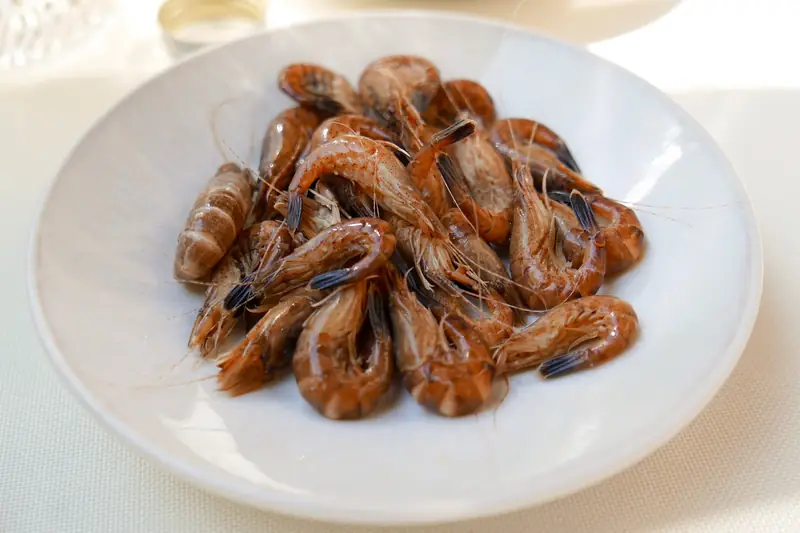
The grey shrimp is officially the common shrimp, or Crangon crangon. It grows to about five to seven centimetres and lives on sandy and muddy bottoms close to the coast. By day it buries itself, so that only the eyes and the feelers stick up above the sand. At night it goes looking for food.
Its colour is grey to brown, with small speckles, and it adjusts that colour to the bottom.
Most grey shrimp are caught by Dutch and German fishermen. The Belgian fleet lands only a small share of the catch. At the table it is different: Belgium eats about half of all the grey shrimp from the North Sea. That says enough about how fond we are of them.
Fresh off the boat: the Vistrap in Oostende
Shrimp are often boiled on board already. That is how they come ashore fresh, and ready to peel.
In Oostende you buy them at the Vistrap, the open-air fish market on the Visserskaai. The market grew up when the harbour was expanded in the nineteenth century. According to Toerisme Oostende, it is the only place in Belgium where you buy shrimp straight from the fisherman. From early in the morning you find fresh North Sea fish there, and grey shrimp from Oostende. After a storm at sea the stalls stay shut, because then nobody has been out fishing.
Elsewhere on the coast, call in at a fishmonger. Do ask whether the shrimp come from the North Sea, and whether they were peeled by hand.
Peeling them yourself
Shrimp in the shell take some work, but that is part of it. With this hold it comes right after a few tries:
- Take the shrimp in both hands, the head in one and the tail in the other.
- Twist the tail piece gently until you feel the shell break.
- Carefully pull the rear piece of shell off.
- Then pull the head, with the rest of the shell, away from the meat.
Count on a good deal of peeling for a modest little tub. Machines still do not manage it as well as fingers: peeling is mostly done by hand, and often far from the coast.
Tomato with shrimp, the classic
Tomaat-garnaal is a fixture of Belgian cooking and of brasserie menus. The recipe is simple. You cut a lid from a tomato, take out the flesh and season the inside with pepper and salt. You mix the shrimp with mayonnaise, and that filling goes into the tomato. A little chopped parsley over the top, and it is ready.
Some cooks add a hard-boiled egg. Lettuce and chips are the usual companions. The dish is usually a starter, and it is a favourite on the table at celebrations.
Where the shrimp croquette comes from
The shrimp croquette grew out of the meat croquette. The first real recipe, with a béchamel of shrimp, probably appeared in 1914. During the First World War shrimp were cheaper than meat, and that is how the croquette became established in Flanders. After the Second World War it became popular in the hotels along the coast.
The base is a roux of butter and milk, let down with stock drawn from the heads and the shells. In go the peeled shrimp, with lemon juice, pepper, salt and nutmeg. The mixture is shaped into small rolls, coated in breadcrumbs and fried golden brown.
How to recognise a good croquette
It is a lot of work, so plenty of croquettes arrive ready-made from the factory. This is what to look for:
- Plenty of shrimp. For the recognised Oostende shrimp croquette the minimum is thirty per cent shrimp, caught by local fishermen. You should be able to see them and taste them.
- A soft, rich filling. It may run when you cut the croquette open, without being watery.
- A taste of the sea. Stock from the heads and the shells gives depth. A filling that mostly tastes of milk and flour is missing that.
- A crisp crust. Thin and brown, with no fat dripping out of it.
- Parsley and lemon. Fried parsley and a wedge of lemon traditionally belong with it.
The Oostende shrimp croquette has been a recognised regional product since 2022. Every year the city also holds a festival at which restaurants compete for the title of best croquette.
Finally
You eat grey shrimp all year, but autumn is a fine moment. In September and October they are at their most numerous and their largest. A bag of shrimp on the quay, or a croquette after a walk on the beach: a day by the sea sometimes needs nothing more. Looking for a base close to the fish? View stays.
Sources: Toerisme Oostende, Wikipedia: grey shrimp, Wikipedia: shrimp croquette, Wikipedia: tomato with shrimp