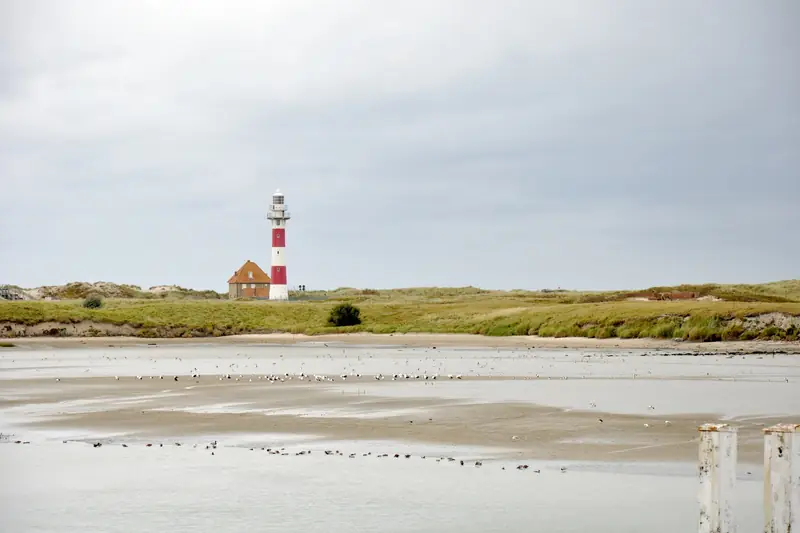
The IJzermonding is a nature reserve of about 130 hectares in Nieuwpoort on the Belgian coast, on the right bank of the IJzer. There you will see mudflats, salt marshes, beach and dunes, with birds such as the spoonbill, avocet, curlew and shelduck. Bring binoculars and come at low tide.
One thing sets it apart: the IJzermonding is not a park but a protected reserve. You look from the paths, the bird hide and the viewing screens. Part of the area is not accessible.
A river mouth in a reserve
According to Natuur en Bos, the IJzer is the only large river in Belgium that flows directly into the sea. In the river mouth, salt and fresh water meet and the tide rules. This creates mudflats, salt marshes, dunes, beach and polders.
The IJzermonding in Nieuwpoort is owned by the Flemish Region and managed by the Agentschap voor Natuur en Bos, the Agency for Nature and Forests. The area is part of the European Natura 2000 site "Dune Areas including IJzermonding and Zwin". According to Wikipedia, no other area on the Flemish coast has a river mouth that connects to beach, foredunes, dune grasslands and polder.
From naval base to nature reserve
The IJzermonding was in poor condition for a long time: silting up, pollution and a naval base that had fallen into decay. In 1993 the Dune Decree protected the former naval base.
Between 1999 and 2003 the dredged material was dug away. Natuur en Bos reports that the buildings and concrete roads were broken up, eight docks and the quays were dismantled and 333,000 cubic metres of dredged silt disappeared. As a result the area of mudflat, salt marsh and dune grew considerably.
You can read more about the role of the IJzer in the First World War in Nieuwpoort and the Ganzepoot in 1914.
Mudflat, salt marsh and dune
Three habitats merge in the IJzermonding. This is how you recognise them:
- Mudflat. The bare, muddy silt plain. At high tide the mudflat is under water twice a day. Worms, crustaceans and small snails live in the mud, the food of fish and birds.
- Salt marsh. The salt marsh lies slightly higher and is covered with plants such as annual sea-blite, glasswort and sea lavender. At spring tide, twice a month, the sea water floods the salt marsh through creeks.
- Dune. Low plants such as large thyme and lady's bedstraw grow in the dry dune grasslands. The wheatear and the stonechat can be found there. A flock of sheep keeps the landscape open.
Birds and seals
You can see birds in the IJzermonding all year round. According to Natuur en Bos, shelduck, redshank, oystercatcher and curlew look for food and rest there on the mudflat, the salt marsh and the beach. Wikipedia also mentions spoonbill, avocet, little egret, cormorant and little grebe.
Outside the breeding season, hundreds of waders join them. Bar-tailed godwit, spotted redshank and dunlin refuel there before they move on. Redshank, grey plover and curlew stay to spend the winter. In winter, songbirds such as linnet, twite, shore lark and snow bunting eat the seeds of the salt marsh plants. At the IJzermonding, Wikipedia shows a ruddy turnstone on the beach. This bird is a common passage migrant and winter visitor along the Belgian and Dutch coast.
If you want to see birds, come at low tide. Oystercatchers and shelducks then look for food on the mudflat. If you are looking for waders that stop briefly to refuel, look outside the breeding season. Check the times of low tide beforehand in a tide table.
Every winter a few seals show up in the IJzermonding, in the harbour channel or on the mudflat. How much distance to keep and what to do about a seal on the beach, you can read in Spotting seals and winter birds on the Belgian coast.
What you may see where
Natuur en Bos laid out cycle and walking paths in the IJzermonding, with information panels along the way. There you will find a bird observation hide, two bird viewing screens and a tidal pool with an amphitheatre. Visit Nieuwpoort recommends boots or suitable footwear, and binoculars.
The map for the approved access regulation for the IJzermonding and Kamp Lombardsijde has five categories: paths for walkers and cyclists, paths for walkers only, inaccessible zones, freely accessible zones and military domain.
According to Visit Nieuwpoort, the reserve itself is not freely accessible. Visits to the nature reserve are accompanied, and access is restricted in the breeding season. Check the regulation on the Natuur en Bos website.
- If you mainly want to watch: stay on the paths and go to the bird hide or a viewing screen.
- If you want to get to know the mudflat up close: ask the Nieuwpoort tourism department for a guided walk.
- If you come with children: Natuur en Bos has an IJzermonding game and a booklet with activities to print out.
How to get there
According to Natuur en Bos, the nearest coast tram stop to the IJzermonding, Lombardsijde Schoolstraat, is 1 kilometre from the main entrance. The bus stop Nieuwpoort Monument Albert is also 1 kilometre away. By bike, the reserve lies between cycle junctions 64 and 73 (Kust).
The ferry from Nieuwpoort Centrum to the IJzermonding only runs at weekends, on public holidays and during school holidays. The walking route from Westende and the return journey by coast tram are in Walking from Westende to Nieuwpoort along the IJzermonding. If you then want to see Nieuwpoort-Stad, read about the rebuilding in Rebuilding Nieuwpoort.
Frequently asked questions
What can you see in the IJzermonding near Nieuwpoort?
You see mudflats, salt marshes, beach, dunes and polders, with birds such as shelduck, oystercatcher, curlew and spoonbill, and a few seals in winter.
When is the best time to watch birds in the IJzermonding?
At low tide, because oystercatchers and shelducks then look for food on the mudflat. Outside the breeding season, hundreds of waders join them to refuel briefly on their migration.
Is the IJzermonding freely accessible?
Partly. You look from the cycle and walking paths, the bird hide and the viewing screens. According to Visit Nieuwpoort, the reserve itself is not freely accessible and visits are accompanied.
Can you visit the IJzermonding with children and a buggy?
Yes. According to Natuur en Bos, wheelchairs and buggies can also use the cycle and walking path. For children there is the IJzermonding game and a booklet with activities that you can download and print.
Where do you stay near the IJzermonding in Nieuwpoort?
On boekdekust.be you book holiday homes on the Belgian coast directly with the owner, and the booking is usually confirmed straight away. Guests pay a service fee. You can read what suits your stay in Holiday home in Nieuwpoort and Nieuwpoort-Bad or Nieuwpoort-Stad.
Finally
The IJzermonding near Nieuwpoort shows in one place how mudflat, salt marsh and dune work together. If you want to stay a few days, you can see holiday homes in Nieuwpoort.
Sources: Natuur en Bos, IJzermonding, Natuur en Bos, IJzermonding leaflet, Natuur en Bos, access regulation map, Wikipedia, IJzermonding, Wikipedia, Steenloper, Visit Nieuwpoort, Nature reserve De IJzermonding