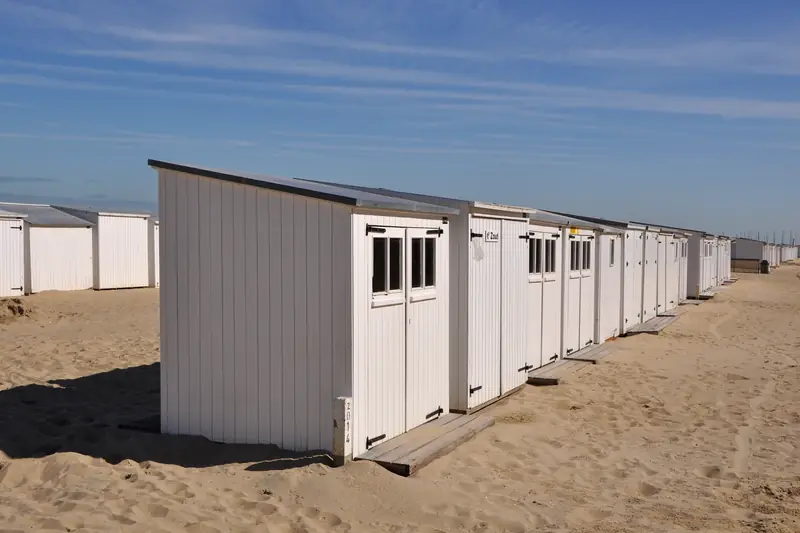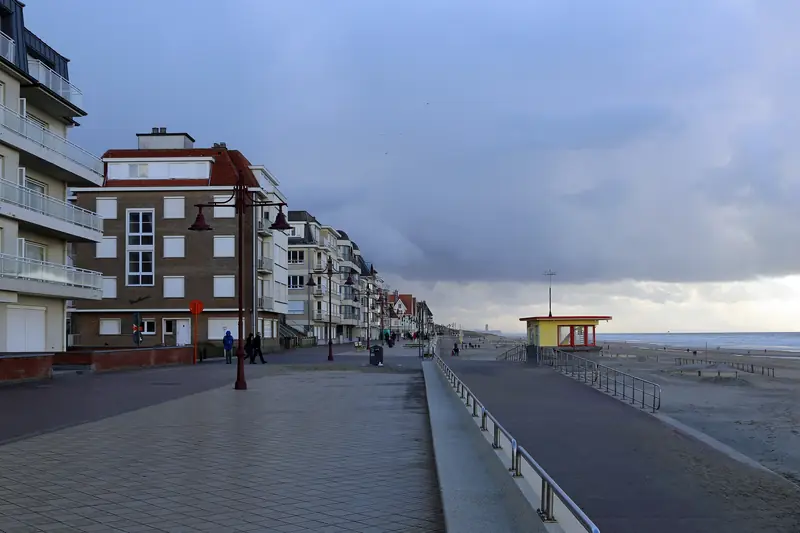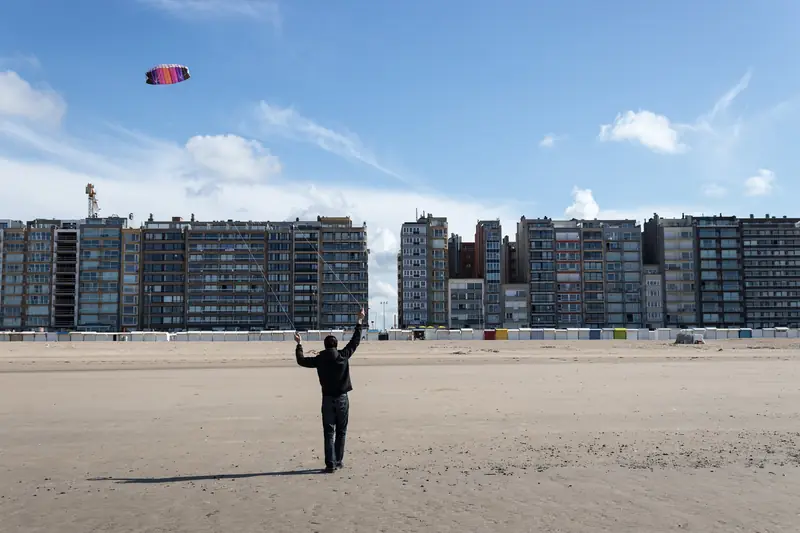
The rebuilding of Nieuwpoort on the Belgian coast followed the First World War, when the town had been almost completely destroyed. The belfry and the Stadshalle on the Marktplein were rebuilt between 1921 and 1923 on the historic model. Nieuwpoort-Bad, the seaside resort, was rebuilt in 1922 and 1923.
Something remarkable: the two parts of Nieuwpoort rose again in different ways. Nieuwpoort-Stad largely got its old face back. In Nieuwpoort-Bad by the sea, according to Onroerend Erfgoed, there are few traces of that rebuilding spirit. The belfry has been on the UNESCO World Heritage List since 1999, even though it is a rebuilt tower.
From rubble to plan
In the First World War, Nieuwpoort lay at the northern tip of the Western Front. The town was destroyed, but the Germans did not take it. You can read how the water helped in the flooding of the IJzervlakte in 1914.
The belfry tower disappeared too. On 17 October 1914, the Belgian army had the hall tower dynamited. It wanted to stop the belfry becoming a target for German artillery, writes the town of Nieuwpoort. Four years of shelling did the rest.
After the war, people who had lost their homes first lived in emergency housing of the Albert Fonds. A wooden barracks district arose on the site of the present town park. The actual rebuilding went fairly fast. According to Onroerend Erfgoed, it was concentrated between 1920 and 1925.
The architect Jozef Viérin from Brugge drew up the rebuilding plan in 1919. All buildings for which enough documentation existed had to come back identical. For the rest, he chose a varied building style with features of the region.
An Advisory Committee under his leadership supervised the work. The street plan and the division into plots of Nieuwpoort-Stad remained largely as before the war.
Belfry and Stadshalle rebuilt
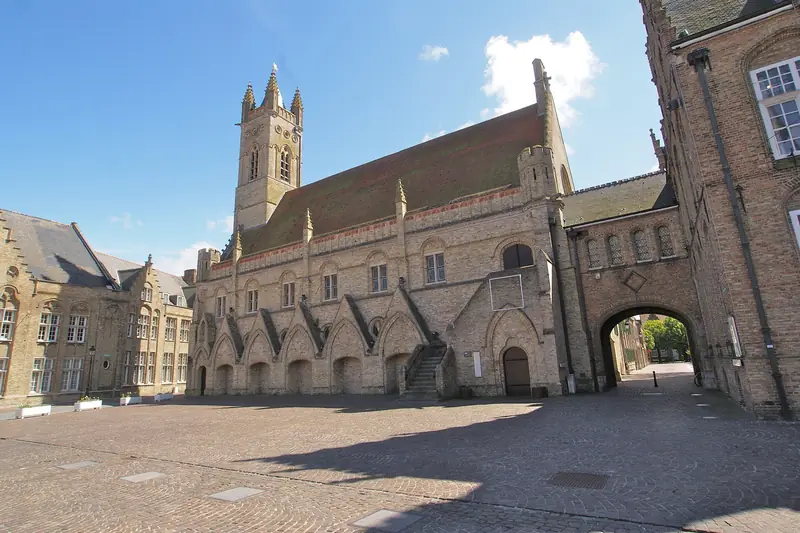
Nieuwpoort's belfry is 35 metres high and stands beside the Stadshalle, the medieval grain hall on the Marktplein. Tower and hall were reconstructed from 1921 to 1923. The town says this was done in the original style and with the same material, under Viérin's direction. Onroerend Erfgoed describes the hall with the belfry and the Onze-Lieve-Vrouwekerk as reconstructed almost identically.
It is not entirely a copy. According to Wikipedia, the crown of the belfry was elaborated, so that the tower looks more like the church towers of the region. The four corner turrets closely resemble those of the Onze-Lieve-Vrouwekerk.
In the rebuilding, the town wanted to concentrate the most important public buildings on and around the Marktplein. The present town hall dates from 1922 and was built in Neo-Flemish Renaissance style. The Second World War left its marks too. In May 1940, the Stadshalle was hit in a German air raid, and the roof partly collapsed.
The belfry on the UNESCO list
Nieuwpoort's belfry has been on UNESCO's World Heritage List since 1999. That year, 32 Belgian belfries were inscribed under the name Belfries of Flanders and Wallonia. In 2005, 23 belfries from northern France and the one in Gembloux were added. The inscription has been called Belfries of Belgium and France ever since.
According to UNESCO, a belfry is the third tower in the townscape, alongside the lord's castle tower and the church tower. It stands for the power of the aldermen.
Nieuwpoort-Bad and the sea wall
Nieuwpoort-Bad was inaugurated as a seaside resort in 1864. The First World War brought its rise to an abrupt halt.
King Albert I moved into Villa Crombez and the General Staff met in the Grand Hôtel des Bains. Both buildings were destroyed. On 11 November 1914, the resort was evacuated.
Rebuilding followed in 1922 and 1923. According to Onroerend Erfgoed, Nieuwpoort-Bad then took on roughly its present appearance. In the 1920s, among others, Le Petit Casino, Le Grand Hôtel and a new villa of Henri Crombez went up. Except for the presbytery, Onroerend Erfgoed sees little in Nieuwpoort-Bad of the rebuilding spirit that marks Nieuwpoort-Stad.
A decree of 26 November 1981 protects the former Villa Crombez on the Zeedijk, with its garden, as a townscape. The reason is its historic and artistic value.
Le Grand Hôtel was designed by the architect Apollon Lagache and dates from 1924. Wikipedia calls it a large Art Deco building. It is known as White Residence.
In 2021, a property developer announced a renovation, in which the building would be named The Grand. Check the current state of affairs with the town of Nieuwpoort.
Until 1949, Nieuwpoort-Bad belonged to the neighbouring village of Oostduinkerke. You can read about that village in holiday home in Oostduinkerke.
Stad and Bad at a glance
A few rules of thumb:
- The rebuilt centre. If you want the belfry and the Marktplein, choose Nieuwpoort-Stad. The old town centre lies a good three kilometres from the coastline.
- The sea wall. If you want to be by the sea, Nieuwpoort-Bad on the Zeedijk suits you better.
- Both. Since 1865, the Albert I-laan has linked Nieuwpoort-Stad with Nieuwpoort-Bad. If you want to see both parts, follow that road.
- Where to stay. If you cannot decide between the two, read Nieuwpoort-Bad or Nieuwpoort-Stad: where to stay. An overview is in holiday home in Nieuwpoort.
- The harbour. If you then want to seek out the water, read about the fish auction of Nieuwpoort.
Frequently asked questions
When was Nieuwpoort's belfry rebuilt?
Nieuwpoort's belfry and Stadshalle were reconstructed from 1921 to 1923 on the historic model. The architect Jozef Viérin led the rebuilding, according to the town of Nieuwpoort.
Is Nieuwpoort's belfry on the UNESCO list?
Yes, since 1999. It is part of the inscription Belfries of Belgium and France, which UNESCO extended in 2005.
How high is Nieuwpoort's belfry?
The belfry is 35 metres high. It stands beside the Stadshalle on the Marktplein in Nieuwpoort.
When was Nieuwpoort-Bad rebuilt?
Nieuwpoort-Bad was rebuilt in 1922 and 1923, after the destruction of the First World War. Le Grand Hôtel dates from 1924.
Where do you stay in Nieuwpoort?
On boekdekust.be, you book holiday homes on the Belgian coast directly with the owner. The booking is usually confirmed straight away. Guests pay a service fee.
Finally
Nieuwpoort-Stad largely recovered its pre-war face, while Nieuwpoort-Bad shows little of that rebuilding spirit. That difference makes a stay in Nieuwpoort interesting, even outside the summer season. If you want to stay the night, you can view holiday homes in Nieuwpoort.
Sources: Town of Nieuwpoort: Stadshalle and belfry, Town of Nieuwpoort: town hall, Onroerend Erfgoed: Nieuwpoort-Stad, Onroerend Erfgoed: Nieuwpoort-Bad, Onroerend Erfgoed: Villa Crombez decree, Onroerend Erfgoed: decree text, UNESCO: Belfries of Belgium and France, Wikipedia: Nieuwpoort belfry, Wikipedia: Nieuwpoort-Bad, Wikipedia: Nieuwpoort, VRT NWS, David Chipperfield Architects: The Grand