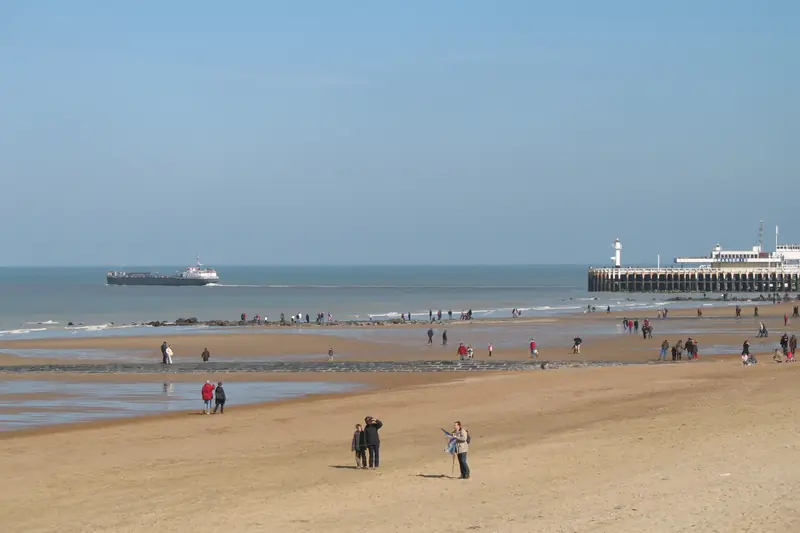
On the Belgian coast you regularly see seals in winter, especially in the harbour channel at Nieuwpoort and by the breakwater in Oostende (Ostend). If a seal is lying on the beach, keep at least 30 metres away, put your dog on a lead and call the NorthSealTeam. Look beyond the seals and in the same months you will see sandpipers that have come from the far north to spend the winter.
Where can you see seals on the Belgian coast
Two species live on the Belgian coast: the common seal and the grey seal. The NorthSealTeam, the volunteers who watch over the seals on the coast, names two regular resting places: the harbour channel at Nieuwpoort and the breakwater in Oostende. According to VRT NWS, seals also regularly lie near the Zwin in Knokke-Heist and on the Klein Strand in Oostende.
In Nieuwpoort you can see the seals at the mouth of the IJzer, often from the lookout tower on the west bank. Birdwatchers report that you can see seals there at both high and low tide. Follow the signs and barriers on site, because the resting places are fenced off.
The number of seals on the coast is rising: ten years ago there were far fewer, according to VRT NWS.
When are there seals on the beach
From January to March you mainly see young grey seals. The pups still have a white coat then, which they shed on the beach. The municipality of De Panne writes that in their first weeks the young animals cannot swim well yet and often stay on the beach for three to four days, sometimes high up into the dunes. That makes them vulnerable. In summer there is a second busy period, with young common seals.
A seal lying alone on the beach is usually not in distress. A pup is often waiting for its mother, who is hunting at sea.
What to do if you see a seal on the beach
The municipality of De Panne and the NorthSealTeam give the same advice:
- Keep at least 30 metres away.
- If the animal looks injured, sick or tangled in a net, keep at least 50 metres away.
- Never stand between the seal and the sea. The animal must always have a clear way to the water.
- Do not touch the seal and do not feed it. Seals can bite and scratch, and they can carry bird flu and bacteria.
- Keep your dog on a lead and well away.
Then call the NorthSealTeam on +32 491 74 32 78. The number is staffed from 08:00 to 22:00. Give the exact location and the condition of the animal, and if you can, send a photo or video via WhatsApp. A volunteer will then come out and screen off the animal.
If a person or a dog does get bitten, see a doctor straight away. The municipality of De Panne points out that a course of antibiotics is needed after a seal bite.
Dogs and seals
SEA LIFE in Blankenberge takes in sick and exhausted seals. At the start of April 2026 the rescue centre told VRT NWS it was seeing noticeably more seals with bite wounds from dogs. In the holidays there are more dogs on the beach, and a dog that slips its lead for a moment can quickly get into a fight with a seal. If you bring your dog to the sea, put it on a lead as soon as you see a seal, even in a zone where dogs may run free.
The NorthSealTeam has existed since 2020 and has about 120 volunteers, spread over seven regions along the coast. The NorthSealTeam or SEA LIFE decides whether a seal needs to go to the rescue centre.
Winter birds on the coast
In winter, shore birds come from the north to the Belgian coast. A few species you can see without much effort:
- Sanderling. A small sandpiper that runs after the retreating waves on the sandy beach. The species breeds on the tundra in the far north, including Greenland, Spitsbergen and northern Siberia, and comes to Belgium in winter.
- Purple sandpiper. This sandpiper almost always sits on stones: harbour walls, breakwaters and piers. In winter it is dark grey and easy to overlook. The largest numbers are seen from October to March.
- Turnstone. Often found with the purple sandpiper on the stones. According to birdwatchers, you will almost always see turnstones and purple sandpipers on the eastern harbour wall in Oostende.
In the IJzer estuary in Nieuwpoort you will also see ducks in winter, such as pintail, teal and wigeon. In the Zwin Natuur Park in Knokke-Heist, the meadow pipit is present from October to March and the corn bunting is a regular winter visitor.
Keep your distance from resting and feeding birds and do not let your dog chase them. Binoculars help.
Frequently asked questions
### Where can you see seals on the Belgian coast? The regular resting places are the harbour channel at Nieuwpoort and the breakwater in Oostende. Seals also regularly lie near the Zwin in Knokke-Heist and on the Klein Strand in Oostende.
### How far should you stay from a seal on the beach? At least 30 metres, and at least 50 metres if the animal looks injured or sick. Never stand between the seal and the sea.
### Who do you call if there is a seal on the beach? The NorthSealTeam on +32 491 74 32 78, available from 08:00 to 22:00. A volunteer will come out. The NorthSealTeam or SEA LIFE in Blankenberge decides whether the animal needs care.
### Which birds can you see on the Belgian coast in winter? On the beach you see sanderlings at the water's edge, and on the harbour walls purple sandpipers and turnstones. In winter the IJzer estuary in Nieuwpoort also has ducks such as pintail, teal and wigeon.
Finally
Winter on the coast is the season of seals and sandpipers. Bring binoculars, keep your distance and check the tide before you set off. View stays
Sources: NorthSealTeam, Municipality of De Panne, VRT NWS: North Seal Team seeks volunteers, VRT NWS: seals with bite wounds, Wikipedia: drieteenstrandloper, Sovon: paarse strandloper, Birdingplaces: eastern harbour wall Oostende, Birdingplaces: IJzermonding, Zwin Natuur Park: de Zwinvlakte