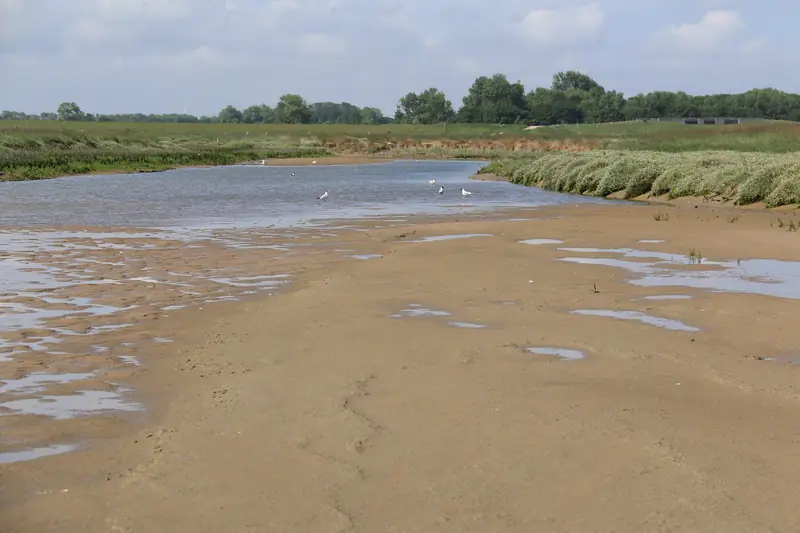
At the far east of the coast, against the Dutch border, the promenade stops and the sea takes over. Twice a day the seawater flows in here and out again. That is the Zwin: a stretch of coast that still lives to the rhythm of ebb and flood, and where birds take the leading part.
A sea inlet that silted up
The Zwin was once a sea inlet linking Brugge with the North Sea. In the twelfth century seagoing ships could sail via the Zwin as far as Brugge, and the city grew into a great trading centre. After that the channel gradually silted up. Brugge could no longer be reached and gained outports, first Damme and later Sluis among other places.
What remains today is a channel with, behind it, a plain of mudflats and salt marshes, beaches and dunes. Count Léon Lippens founded the nature reserve Het Zwin here in 1952. Since 2006 the area has been in the hands of the Province of West-Vlaanderen and the Agentschap voor Natuur en Bos. They turned it into the present Zwin Natuur Park, which opened in 2016.
Mudflats and salt marshes
Mudflats are the low, muddy parts that flood at every high tide. Salt marshes lie a little higher and are covered with plants that can cope with salt. Together they form the Zwinvlakte. Through an opening in the dunes the seawater flows into the creeks and narrow channels twice a day. From the bridge over the Zwingeul you see it happen: on the rising tide the water runs one way, at ebb the other.
Twice a month it is spring tide and the lowest parts of the plain stand under water. A few times a year spring tide coincides with a strong westerly storm. Then the whole Zwinvlakte floods and the paths across the plain are closed.
Storks and other birds
The stork is the mascot of the park. In the 1960s storks were released here, after the species had disappeared as a Belgian breeding bird at the end of the nineteenth century. The Zwin and the area around it are still one of the most important breeding areas in the country.
From February until the end of July the storks sit on their nests. The young fly the nest in the first weeks of July, and around mid-August most of the birds leave. A small number spend the winter nearby. In the park a stork tower brings you level with the nests.
Outside the stork season there is plenty to see as well. Waders are there all year. Already 40 species have been counted in the park, and you see the largest numbers during migration in spring and in autumn. Spoonbills are most numerous in August and September. From October the geese from the north join them.
Sea lavender in summer
In summer the Zwinvlakte turns purple. That comes from the sea lavender, also called Zwinneblomme in the region. The plant grows on the boundary between mudflats and salt marshes, in places the seawater reaches regularly. Glasswort, sea aster and other salt-loving plants flower then too. According to the park, July to September is the best period to see them in flower.
You can walk up to the sea lavender on the green loop and the blue loop through the Zwinvlakte. Stay on the paths and leave the flowers standing, so the next visitor has something to enjoy as well.
How you visit the park
You start in the visitor centre, with an exhibition on bird migration. Then you choose your walk:
- The hide trail is 1.7 kilometres long and runs past themed hides where you watch birds from close by. It is suitable for pushchairs and wheelchairs.
- The green loop (1.9 kilometres) and the blue loop (2 kilometres) lead through the Zwinvlakte itself. Allow about an hour for each loop. These paths are not accessible to wheelchairs.
- The viewing centre is under cover and has a wide window with a view of the plain. Handy when it is windy or wet.
On the roof of the visitor centre stands a panorama tower with a view of the polders, the dunes and the sea.
Practical matters
The park lies on the Graaf Léon Lippensdreef in Knokke-Heist. You can get there on foot, by bicycle, by public transport or by car. There is a covered bike shelter for cyclists. From Knokke station you can book a flex bus in advance.
A few more things to know before you leave:
- Put on waterproof shoes or boots if you want to go into the Zwinvlakte.
- Take binoculars if you have a pair.
- Dogs are not allowed in the park, except guide dogs for the blind.
- The plain lives with the tide. In a storm or at spring tide, paths can be closed.
Opening days and tickets are on the website of Zwin Natuur Park. Look there before you leave, because outside the holidays the park is not open every day.
Finally
The Zwin shows the coast as it was before there were promenades: wet, briny and full of life. It is a quiet counterpart to the busy seafront, different in every season. If you are staying on the east coast, you are there in no time. View stays.
Sources: Zwin Natuur Park, Zwin Natuur Park: the Zwin plain, Zwin Natuur Park: our storks, Zwin Natuur Park: history, Wikipedia: Zwin, VRT NWS