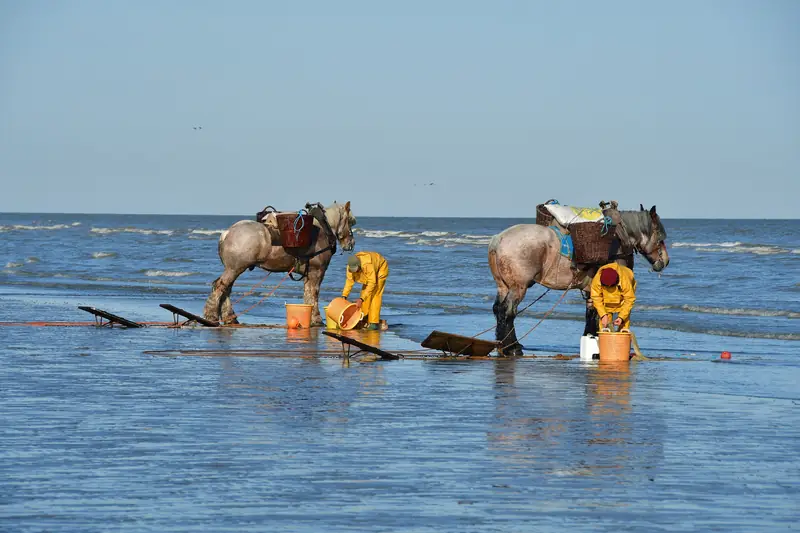
NAVIGO Visserijmuseum is in Oostduinkerke, a district of Koksijde on the Belgian coast. The museum tells the story of fishing. You see the wooden coastal fishing vessel OD.1 Martha, aquariums with North Sea animals and the skeleton of sperm whale Valentijn. The museum opened fully renovated in 2024.
What NAVIGO tells about the beach fishers, you see again outside on the beach. On the beaches of Koksijde and Oostduinkerke, people fish in more ways than on horseback alone. The museum gives an overview of these techniques, so you can see the difference on your beach walk.
What you see at NAVIGO Visserijmuseum
The displays at NAVIGO Visserijmuseum tell the story of fishing in all its facets. They cover the Iceland fishers, the beach fishers and the fishing families, with ship models, an art collection and a fisher's cottage. These are some of the parts:
- OD.1 Martha. A wooden coastal fishing vessel, according to Wikipedia a fishing boat from before the Second World War. Vessels from the Oostduinkerke of that time carried the registration letters OD.
- Aquariums. Four aquariums hold about 180 animals of 19 species. This part of NAVIGO is a recognised zoo.
NAVIGO carries the blue dot of museumPASSmusées, the label for museums that suit children. What children can do in Oostduinkerke, you can read in Oostduinkerke with children.
Sperm whale Valentijn, from beach to museum
Sperm whale Valentijn washed up on 12 February 1989 on the beach of Sint-André in Koksijde. According to Wikipedia, the sperm whale was 17 metres long and weighed 25 tonnes. The carcass was buried near the abbey farm Ten Bogaerde, with the intention of digging up the skeleton later.
In 2019 Valentijn was dug up. The team of Professor Pieter Cornillie of Universiteit Gent made the skeleton ready for the museum. That skeleton is 13 metres long and has hung in NAVIGO since the end of 2024. According to the museum, the beach of Sint-André is three kilometres further on.
Passive beach fishing: nets waiting for low water
In passive beach fishing, the fishing gear stands on the beach, in the tidal zone. The fisher comes to collect the catch at low water. That low water comes twice a day, and at a different moment every day. NAVIGO describes these forms:
- Flat nets. Rectangular nets that lie horizontally on the beach, with three sides dug in. Fish that come towards the beach at high tide are stuck when the tide goes out. They are mainly flatfish such as sole, dab and flounder.
- Kartenetten. Fyke-shaped nets with a wide opening and a long pocket. Floats keep the opening open. In 2017 Koksijde was the first coastal municipality to require a fore net, so that seals and porpoises do not drown in them.
- Stakenetten. Related to kartenetten, but buried stakes keep the net open instead of floats.
- Kordeel. A long fishing line with side lines, hooks and bait. The fisher buries the line at low tide and takes the catch off the hooks when the line lies dry. Other names are strandbeug and hoekwant.
- Round fyke nets. Rare along the Belgian coast: funnel-shaped nets that stand parallel to the waterline.
Active beach fishing: kruiers, horses and anglers
In active beach fishing, the fisher or the horse pushes or pulls the net. NAVIGO also counts anglers and bait diggers here.
- Kruien with a drag net. The fisher drags a net himself through shallow water, up to his waist, in waders and a yellow oilskin jacket. This is called kruwen. Kruien runs from two to one and a half hours before low water until low tide, usually from April to October. The kruiers fish for shrimp. If you want to taste them, read about grey shrimp and shrimp croquettes.
- Kruien with a push net. A very old form that still occurs on a limited scale. The fisher pushes the net ahead of him on a wooden handle. The classic child's net from the sea wall is based on it. In the past it was often the wives of fishers who did this work.
- Shrimp fishers on horseback. Here the horse pulls the net. The oldest known written mention of it in Oostduinkerke dates from 1563. How it works, you can read in the horseback shrimp fishers of Oostduinkerke.
- Anglers. They use no net but baited hooks on a line. On the Belgian coast they fish from the beach, the breakwaters, the pile jetties of Nieuwpoort and Blankenberge, the pier of Blankenberge and the harbour breakwater of Oostende.
- Bait diggers. They look for lugworms as bait for anglers. Lugworms leave sandy little heaps on the beach. The worms are mostly pumped up; in the past people dug them up with a bait spade.
Spotting and recognising beach fishers
If you are looking for beach fishers, come around low water. The kruiers fish then, and passive nets are collected then. Check the tides on the website of the municipality of Koksijde.
A few rules to remember:
- If someone stands waist-deep in the sea and drags a net behind him, he is doing kruien with a drag net. If he pushes the net ahead of him, he is using a push net.
- If a net lies flat in the sand with three sides dug in, it is a flat net, which mainly catches flatfish.
- If you see sandy little heaps, lugworms are sitting underneath.
Keep away from nets and lines. The fisher comes to collect them himself at low water. You combine a beach walk with walking in Oostduinkerke.
Frequently asked questions
What is there to see at NAVIGO Visserijmuseum in Oostduinkerke?
NAVIGO shows the history of fishing, the OD.1 Martha, aquariums with North Sea animals and the skeleton of sperm whale Valentijn.
Where can you see the skeleton of sperm whale Valentijn?
The skeleton of sperm whale Valentijn hangs in NAVIGO Visserijmuseum in Oostduinkerke, in a museum wing that opened in 2024. The sperm whale washed up in 1989 on the beach of Sint-André in Koksijde.
May you lay nets yourself on the beach of Koksijde?
A permit is needed to lay small nets. NAVIGO writes that Koksijde issues it in September for the period from 1 October up to and including 31 May. The current rules are on recreatievezeevisserij.be, a project of VLIZ and ILVO.
Where do you stay near NAVIGO in Oostduinkerke?
On boekdekust.be you book holiday homes on the Belgian coast directly with the owner. The booking is usually confirmed straight away. Guests pay a service fee. Read more about a holiday home in Oostduinkerke or a holiday home in Koksijde.
Finally
NAVIGO Visserijmuseum in Oostduinkerke gives context to what you see on the beach: boats, animals, a sperm whale and the beach fishers themselves. Check opening hours and tickets beforehand on the museum's website. If you are looking for a place to stay overnight, you can view holiday homes in Oostduinkerke.
Sources: NAVIGO, welcome, NAVIGO, with the family, NAVIGO, sperm whale Valentijn, NAVIGO, Sint-André, NAVIGO, our beach fishers, NAVIGO, passive fishing, NAVIGO, flat nets, NAVIGO, kartenetten, NAVIGO, stakenetten, NAVIGO, kordeel, NAVIGO, round fyke nets, NAVIGO, active fishing, NAVIGO, drag net, NAVIGO, push net, NAVIGO, horseback fishing, NAVIGO, angling, NAVIGO, bait diggers, NAVIGO, legislation, Municipality of Koksijde, tides, Wikipedia, NAVIGO Visserijmuseum, Wikipedia, Valentijn van Sint-André