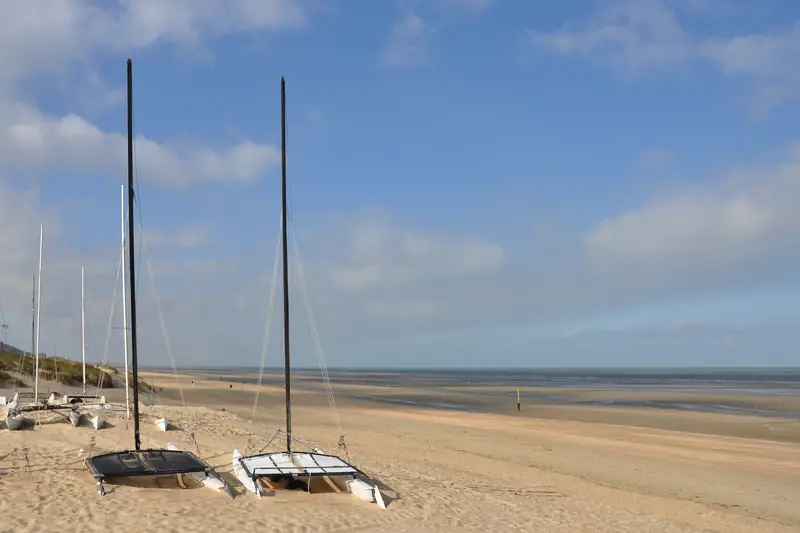
A Berliner doughnut is a round ball of deep-fried yeast dough, filled with pastry cream or jam and dusted with icing sugar. On the Belgian coast, Berliner doughnuts have been sold on the beach since 1905. On the beach at Koksijde, that tradition is returning, following a concession from the municipality.
Worth knowing: according to the Bakkerijmuseum in Veurne, the story of the Berlin baker who is said to have invented the doughnut is a myth. The sources also disagree about the name Boule de l'Yser.
What is a Berliner doughnut
In Flanders, the Berliner doughnut is also called Boule de Berlin or Berlinerbol. The pastry is made of deep-fried yeast dough with a filling of pastry cream or jam. Icing sugar goes on top, sometimes with a little cinnamon.
There is a simple rule for the filling. If you like the oldest recipe, choose jam: the oldest recipes used apricot jam, sometimes plums or redcurrants. If you like cream, choose pastry cream. That variant appears in France, Belgium and the Netherlands in the late nineteenth and early twentieth century.
Where does the name come from
The name Berliner doughnut probably refers to the Berliner Pfannkuchen, a term that became popular in Europe in the middle of the nineteenth century. That is what VRT NWS writes. According to the Bakkerijmuseum in Veurne, the pastry already appeared in German-speaking Europe around 1700, under names such as Pfannkuchen and Krapfen.
The museum calls the story of the Berlin baker who invented the pastry after being rejected as a soldier a culinary myth. How the doughnut ended up in Belgium cannot be said with certainty. The museum points to French recipe books, which Belgian pastry chefs read in the nineteenth century.
Then there is the Boule de l'Yser. In certain parts of Belgium, the version with pastry cream goes by that name, after the river IJzer. One story says the name replaced the word Berlin after the First World War. The Bakkerijmuseum in Veurne calls that a myth and dates the boules de l'Yser to the 1950s or 1960s. The Dutch Wikipedia says the same. So the sources do not agree on the year in which that name arose.
Since when have beach vendors sold Berliner doughnuts
Selling Berliner doughnuts on the beach on the Belgian coast goes back to 1905. The town archive of Blankenberge holds the minutes of the municipal council of 13 July 1905. In them, a man from Brussels asks permission to hawk Berliner doughnuts on the beach and the sea wall of Blankenberge. That request was refused, but earlier that year he had already been granted a permit. In 1907 he was given permission again, but against payment of a levy. The town introduced a concession system.
A vendor in De Haan says his father still called out his wares: “Fresh doughnuts with cream or jam”. His student workers now use a whistle. A vendor in Blankenberge and Knokke-Heist calls the period from 21 July to 15 August the peak of the season.
Berliner doughnuts on the beach at Koksijde
On many beaches on the Belgian coast, beach selling has disappeared. In Koksijde it is back. According to VRT NWS, the municipality of Koksijde approved a concession for selling Berliner doughnuts on the beach. The zone runs from Sint-Idesbald to Koksijde-Bad and from Oostduinkerke-Bad to Groenendijk. Read what Sint-Idesbald has to offer if you are staying around Sint-Idesbald.
A local bakery provides the beach sales. It makes the doughnuts itself and goes out with carts fitted with cooling elements, so that the doughnuts stay fresh in warm weather. Beach selling in Koksijde runs in summer. A concession can change: check the current situation on the website of the municipality of Koksijde.
How to get a doughnut on the beach
Sales depend on season, weather and stock. Keep these points in mind:
- Weather. In bad weather, the baker in Koksijde does not send his student workers onto the beach. If you are looking for a Berliner doughnut, choose a dry day.
- Stock. On some days the doughnuts sell out, on other days some are left over. So do not count on a guarantee.
- Zone. The concession applies from Sint-Idesbald to Koksijde-Bad and from Oostduinkerke-Bad to Groenendijk. If you are on another stretch of beach, it does not apply there.
- Other seaside resorts. In Knokke-Heist, Blankenberge and De Haan too, vendors walk along the beach with doughnuts.
More to taste and see around Koksijde
If you want more to eat by the sea, read about grey shrimps and shrimp croquettes. If you are looking for a walk after the beach, the Hoge Blekker and the Noordduinen fit well. If you would rather have culture, choose the Abdijmuseum Ten Duinen.
In winter, fried doughnuts make you think of New Year's Eve: people traditionally ate Berliners around the turn of the year and during carnival. If you are staying by the sea then, you will find tips at Christmas and New Year's Eve by the sea.
Frequently asked questions
What is a Berliner doughnut?
A Berliner doughnut is a round treat of deep-fried yeast dough, filled with pastry cream or jam and dusted with icing sugar. In Flanders it is also called Boule de Berlin.
Where are Berliner doughnuts sold on the beach at Koksijde?
According to VRT NWS, the concession covers the beach from Sint-Idesbald to Koksijde-Bad and from Oostduinkerke-Bad to Groenendijk. Check the current situation on the website of the municipality of Koksijde.
What is the difference between a Berliner doughnut and a Boule de l'Yser?
In certain parts of Belgium, the version with pastry cream is called Boule de l'Yser, after the river IJzer. The sources differ on when that name arose.
Since when have Berliner doughnuts been sold on the beach?
Beach selling on the Belgian coast goes back to 1905. In that year, a man from Brussels asked the municipality of Blankenberge for permission to hawk Berliner doughnuts on the beach.
Where do you stay in Koksijde?
On boekdekust.be you book holiday homes on the Belgian coast directly with the owner. The booking is usually confirmed straight away. Also read about a holiday home in Koksijde.
Finally
The Berliner doughnut has belonged to the Belgian coast for more than a century, and on the beach at Koksijde it is back. Choose a dry day, stay within the zone and check the current rules with the municipality. If you are looking for somewhere to stay nearby, you can view holiday homes in Koksijde.
Sources: VRT NWS, Berliner doughnuts are back on the beach at Koksijde, VRT NWS, Why are boules de Berlin sold on the beach in Belgium, VRT NWS in English, Berliner doughnuts make comeback on Flemish beaches, Wikipedia, Berlinerbol, Wikipedia, Boule de Berlin